

Availability: In Stock
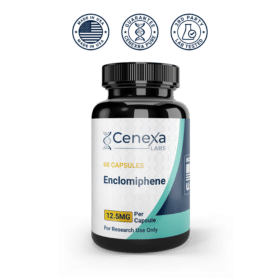
Enclomiphene Capsules
$89.99 Original price was: $89.99.$79.99Current price is: $79.99.
Enclomiphene is an isolated clomiphene isomer studied for raising natural testosterone production without shutting down fertility signaling.
 Earn $3 Cenexa Bucks when you buy this product!
Availability: In Stock
A portion of every order supports organizations focused on children’s cancer research & care. Help us make a difference.
 Buy More & Save!
Add selected quantity to cart above & discount is automatically applied.
| Quantity | Discount % | Price Per Item |
|---|---|---|
| 3-6 | 4 | $76.79 |
| 7-9 | 7 | $74.39 |
| 10-50 | 9 | $72.79 |
Quick Links
Enclomiphene Capsules
The Axis-Preserving Testosterone Compound
Also known as: Enclomiphene citrate, (E)-clomiphene, trans-clomiphene, Androxal, EnCyzix, ICI-46476, RMI-16289
Capsule Format | 12.5 mg per capsule | 60 capsules per bottle | USA-Made
Why Researchers Choose Enclomiphene
Most compounds studied for raising androgen levels do so by supplying androgen from the outside, which suppresses the very signaling pathway researchers often want to observe. Enclomiphene works from the opposite direction: it blocks estrogen feedback at the hypothalamus and pituitary so the body’s own LH and FSH output rises, leaving the hypothalamic-pituitary-gonadal (HPG) axis active and measurable throughout the study window. That makes it one of the few tools available for investigating androgen elevation and gonadotropin signaling at the same time, in the same model.
What It Is
Enclomiphene citrate is the trans-isomer of clomiphene citrate, isolated and studied on its own rather than as part of the racemic mixture. Think of clomiphene as a two-component mixture where only one component drives the anti-estrogenic activity, and enclomiphene is that component separated out.
Research interest developed because the discarded isomer, zuclomiphene, carries weak estrogen agonist activity and a half-life measured in weeks rather than hours, which confounds interpretation of the racemic compound. Enclomiphene was advanced through clinical development as Androxal by Repros Therapeutics for secondary hypogonadism, but the program received three Complete Response Letters from the FDA and was discontinued in December 2015. It has never been approved as a standalone product. Enclomiphene is also listed under Section S4 (Hormone and Metabolic Modulators) of the WADA Prohibited List, which is relevant context for any research design touching anti-doping detection or athlete populations.
How It Works (What Makes It Interesting)
Studies indicate enclomiphene may influence endocrine signaling through several mechanisms:
- Estrogen receptor antagonism at the hypothalamus and pituitary – Occupies estrogen receptors without activating them, so estradiol cannot deliver its normal inhibitory signal to the upstream endocrine centers
- Negative feedback interruption – With estradiol signaling blocked, the hypothalamus reads the environment as estrogen-depleted and increases pulsatile GnRH (gonadotropin-releasing hormone) release
- Gonadotropin elevation – Downstream LH and FSH secretion from the anterior pituitary rises, with LH acting on testicular Leydig cells and FSH on Sertoli cells
- Endogenous androgen stimulation – Because the signal originates upstream, testosterone production is driven by the gonad itself rather than supplied exogenously, and spermatogenesis signaling is not withdrawn
- Isomeric selectivity – Unlike the racemic parent compound, enclomiphene shows no meaningful estrogen agonist activity, so studies are not confounded by mixed agonist and antagonist effects in the same sample
- Distinct pharmacokinetic profile – Reported elimination half-life of approximately 10 hours with hepatic metabolism via CYP2D6 and CYP3A4, compared with the multi-week accumulation and lipophilic partitioning attributed to zuclomiphene
Common Research Applications
- HPG Axis & Endocrine Signaling: Secondary hypogonadism models, hypogonadotropic hypogonadism, estradiol negative feedback mapping, GnRH pulsatility studies, gonadotropin dose-response curves
- Male Reproductive Research: Spermatogenesis preservation models, oligospermia models, Leydig cell steroidogenesis, Sertoli cell function assays, post-suppression axis recovery models
- Comparative Androgen Studies: Endogenous stimulation versus exogenous androgen administration, transdermal testosterone comparator arms, gonadotropin suppression and rebound timelines, axis shutdown reversal models
- Estrogen Receptor Pharmacology: ER-alpha versus ER-beta binding studies, SERM tissue-selectivity comparisons, isomer-resolved binding assays, competitive displacement studies against estradiol
- Metabolic Model Research: Obesity-associated hypogonadism models, insulin resistance studies, type 2 diabetes models, adiposity and lean mass endpoint analysis
- Bone & Lipid Endpoint Studies: Bone mineral density under low-estradiol conditions, bone turnover marker analysis, lipid panel shift investigation, estradiol threshold determination
- Analytical & Pharmacokinetic Methods: Stereospecific chiral assay development, isomer separation and quantification, CYP2D6 and CYP3A4 metabolism studies, anti-doping detection method validation
What You’re Getting
Every batch of our Enclomiphene Capsules meets rigorous research standards:
- Exceeds 99% Purity – Verified by HPLC analysis
- Certificate of Analysis (COA) – Published for every batch, showing purity and identity confirmation
- Precisely Dosed Capsules – Consistent per-capsule content at 12.5 mg for reliable research use.
- Manufactured in USA – GMP-certified facilities with full traceability
- Stable Storage Format – Room-temperature stable solid format with no cold-chain handling or reconstitution step
- Fast Shipping – Most orders ship same day. We offer flat rate shipping and 2-3 day delivery in the USA
Add To Cart
Click the “Add To Cart” button to grab your Enclomiphene Capsules today!
Research Use Only
Research Use Only
This product is intended strictly for laboratory research purposes. Not for human consumption, clinical use, veterinary applications, or any diagnostic or therapeutic purposes.
Enclomiphene Research & Scientific Overview
Jump to: Structure | Mechanism | Studies | Pharmacokinetics | Limitations | Lead Researcher | References
Enclomiphene Molecular Structure & Chemical Properties
Enclomiphene occupies an unusual position among research compounds: it advanced through Phase II and Phase III human trials before development halted. It is the trans (E) isomer of clomiphene citrate, a triphenylethylene selective estrogen receptor modulator (SERM) used in reproductive medicine since the 1960s[1]. Racemic clomiphene contains two isomers, enclomiphene and zuclomiphene, with markedly different receptor behavior and clearance; isolating the trans isomer was the rationale for developing enclomiphene as a separate entity[2,3]. Note that enclomiphene is a small molecule, not a peptide.
Chemical Structure
[IMAGE PLACEHOLDER] Insert 2D chemical structure image here Image URL: https://pubchem.ncbi.nlm.nih.gov/image/imgsrv.fcgi?cid=6420009&t=l Alt text: Enclomiphene citrate 2D molecular structure diagram Source credit: PubChem Position: Center-aligned below heading
2D molecular structure (Source: PubChem)
Technical Specifications
| Property | Value |
|---|---|
| CAS Number | 7599-79-3 (citrate salt); 15690-57-0 (free base) |
| Molecular Formula | C32H36ClNO8 (subscripted) – citrate; C26H28ClNO (subscripted) – free base |
| Molecular Weight | 598.1 g/mol (citrate); 406.0 g/mol (free base) |
| Chemical Class | Triphenylethylene selective estrogen receptor modulator; trans (E) isomer of clomiphene |
| IUPAC Name | 2-[4-[(E)-2-chloro-1,2-diphenylethenyl]phenoxy]-N,N-diethylethanamine |
| Half-Life (Plasma) | Approximately 8-10 hours (human studies) |
| Stability | Solid citrate salt stable at ambient conditions; light-sensitive |
| Solubility | Soluble in DMSO and ethanol; limited aqueous solubility |
| Storage | 15-30 degrees C, protected from light and moisture (stability data varies by formulation) |
The chlorinated ethylene bridge fixes the geometry of the two phenyl groups, and this fixed trans configuration produces predominantly antagonist behavior at the estrogen receptor, in contrast to the partial-agonist character of the cis isomer[2,3].
Enclomiphene Mechanism of Action
Enclomiphene acts upstream of the gonads rather than at target tissue. Its primary mechanism is competitive antagonism of estrogen receptors in the hypothalamus and anterior pituitary, altering gonadotropin output and downstream testicular signaling[1,2].
Primary Cellular Pathways
Hypothalamic Estrogen Receptor Antagonism – Feedback Interruption
Estradiol normally suppresses gonadotropin-releasing hormone (GnRH) pulse generation. Research indicates enclomiphene occupies hypothalamic and pituitary estrogen receptors without activating them, lifting this suppression[1,2]:
- Increased GnRH pulse frequency and amplitude
- Elevated luteinizing hormone (LH) and follicle-stimulating hormone (FSH) secretion
- Effects documented on 24-hour hormone sampling[4]
LH-Driven Leydig Cell Stimulation
Elevated LH acts on testicular Leydig cells, increasing endogenous testosterone synthesis where the hypothalamic-pituitary-gonadal axis is intact[1,4]. Because the signal originates upstream, LH and FSH rise during administration rather than falling, the pattern separating this mechanism from exogenous androgen administration.
FSH Support of Spermatogenesis
FSH acts on Sertoli cells, which support germ cell maturation. In comparative studies, sperm concentrations held or increased in enclomiphene arms while gel comparator arms declined[5,6,7].
Isomer-Specific Receptor Pharmacology
Zuclomiphene, the cis isomer, is a partial estrogen agonist that clears far more slowly and accumulates with repeated administration, becoming the predominant circulating isomer in men on long-term clomiphene – the argument for isolating the trans isomer[3,8].
[CALLOUT BOX – Highlighted] Key Mechanistic Insight: Enclomiphene’s mechanism is indirect – it modifies a feedback loop rather than binding an androgen receptor. An intact pituitary and responsive testicular tissue are prerequisites for any observed effect, so models of primary gonadal failure would not be expected to respond. [END CALLOUT BOX]
Enclomiphene Research Applications & Key Findings
Pharmacodynamic and Dose-Ranging Research
A randomized two-center study compared three oral doses (6.25, 12.5, and 25 mg) against transdermal testosterone in secondary hypogonadism, sampling hormones hourly across 24 hours[4]:
- Consistent elevation of total testosterone into the reference range across doses
- LH and FSH increases extending above the reference range
- Effects persisting at least one week after administration stopped, with no temporal alignment between peak drug concentration and peak hormone response
Comparative Research Against Exogenous Testosterone
Phase II Studies
A proof-of-principle study in 12 men previously using topical testosterone compared 25 mg daily against testosterone gel[5], and a Phase IIB study (ZA-203) enrolled 124 men with morning testosterone below 250 ng/dL across four arms[6]. Reported outcomes:
- Morning testosterone increases comparable to the topical comparator
- Increased LH and FSH in enclomiphene arms; suppression in the gel arm
- Sperm counts conserved in enclomiphene arms, with estradiol increased across all active arms
Phase III Studies
Two parallel randomized, double-blind, placebo-controlled Phase III trials (ZA-304 and ZA-305) compared two doses against testosterone gel over 16 weeks in overweight men aged 18 to 60 with baseline testosterone at or below 300 ng/dL[7]. Testosterone rose in all active arms; sperm concentration held in the enclomiphene arms and fell substantially in the gel arm.
Isomer, Safety, and Preclinical Literature
Isomer-resolved assays tracked accumulation of zuclomiphene across consecutive clomiphene cycles in anovulatory women[10]. A retrospective comparison against racemic clomiphene reported a lower adverse event rate in the enclomiphene group[11], and a 400-patient review of long-term clomiphene use remains the largest long-duration dataset in this class[12]. Preclinically, microsomal work established CYP2D6 as the dominant metabolic route[9], and rodent studies examined the separated isomers on reproductive organ weight and germ cell development[2].
[CALLOUT BOX – Highlighted] Important Context: Enclomiphene is unusual among research compounds in having substantial human trial data – but that data was judged insufficient for regulatory approval. Trial endpoints were hormonal and sperm-count measurements, not fertility outcomes or symptom resolution, and this gap between surrogate and clinical endpoints is what regulators cited. [END CALLOUT BOX]
Enclomiphene Pharmacokinetics & Metabolism
Absorption & Distribution
All published human dose-ranging work used oral administration[4,5]:
- Oral absorption with peak plasma concentrations reported at roughly 4 to 6 hours, supporting once-daily protocols
- Highly protein-bound and lipophilic, consistent with the triphenylethylene class
Metabolism & Elimination
Human liver microsome work identified CYP2D6 as the primary enzyme metabolizing enclomiphene, with quinidine abolishing metabolism and ketoconazole showing little effect in most preparations[9]:
- Plasma half-life of approximately 8 to 10 hours in human studies[8]
- 4-hydroxylated and des-ethylated metabolites described for the parent structure
- CYP2D6 metabolizer status a plausible source of interindividual variability
- Zuclomiphene, by contrast, persists for weeks and accumulates[8,10]
A disconnect exists between clearance and effect: gonadotropin and testosterone elevations remained measurable about a week after administration ceased, far beyond what the half-life predicts, suggesting a reset feedback loop rather than continuous receptor occupancy[4].
Excretion Pathways
- Hepatic metabolism, biliary excretion of conjugated metabolites, and enterohepatic recirculation described for the clomiphene structure
- Renal contribution to parent compound clearance not well quantified
Common Model Organisms
- Humans – the primary dataset, spanning Phase I through Phase III populations
- Rats – reproductive organ and germ cell studies of the separated isomers
- Human liver microsomes and cell-based receptor assays – metabolic attribution and estrogen receptor binding
Research Limitations & Regulatory Status
Critical Gaps in Current Evidence
Enclomiphene inverts the usual pattern for research compounds. Human data is not the gap; the gap is that regulators reviewed it three times and found it inadequate. Three New Drug Applications between 2009 and 2015 each received a Complete Response Letter citing Phase III design adequacy, entry criteria, titration, and bioanalytical method validation; additional Phase III work was requested, never completed, and no sponsor has filed since[13].
Endpoint, Duration, and Mechanistic Gaps
- Surrogate endpoints only – hormone and sperm-count measures, not pregnancy rates or symptom resolution
- Longest controlled exposure was roughly 6 months; class cardiovascular questions remain unresolved[12]
- Tissue-level receptor selectivity is incompletely mapped, and the persistence of effect after clearance is unexplained[4]
- Visual disturbance signals reported for racemic clomiphene are uncharacterized for the isolated isomer, and trial populations were narrow: overweight men, 18 to 60, intact pituitary
Regulatory & Competitive Sport Status
FDA Position
- Not approved for any indication, and no approved label exists, so no reference safety or dosing specification is available
- Not a dietary supplement ingredient; listed on Department of Defense prohibited ingredient guidance[14]
- Research material meets no FDA-recognized product standard; purity and isomer ratio vary by source
WADA Prohibition
- Class S4.2 (Anti-Estrogenic Substances, including SERMs), prohibited at all times in and out of competition[15]
- Clomifene is named explicitly, and the class covers unnamed compounds of the same activity[15]
- Enclomiphene is a component isomer of clomifene and shares its analytical signature; no therapeutic use exemption basis exists for testosterone elevation in male athletes
Research Classification: Enclomiphene is available only for laboratory research use. It is not intended for human consumption, medical use, or veterinary applications. All research must be conducted under appropriate ethical oversight and regulatory compliance with institutional review board approval where applicable.
Lead Researcher Spotlight
Ronald D. Wiehle, PhD
Former Chief Scientific Officer Repros Therapeutics Inc., The Woodlands, Texas, United States
Dr. Ronald Wiehle led the program that separated enclomiphene from racemic clomiphene and carried it through pharmacokinetic characterization, dose-ranging work, and the Phase II and Phase III trials, and is an author on most of the primary enclomiphene literature.
His published contributions include:
- Pharmacodynamic and pharmacokinetic characterization of oral dosing
- Comparative trial design against transdermal testosterone
- Isomer-resolved serum measurement of enclomiphene and zuclomiphene
Transparency note: Most primary enclomiphene literature comes from one industry-sponsored program in which Dr. Wiehle was an employee of the sponsor. That concentration of authorship is a recognized limitation of the evidence base.
Disclaimer: This spotlight is provided for educational purposes to acknowledge scientific contributions to enclomiphene research. Cenexa Labs has no affiliation with Dr. Ronald Wiehle or Repros Therapeutics Inc., and this information does not constitute an endorsement of any products or services.
References
- Rodriguez, K.M., Pastuszak, A.W., & Lipshultz, L.I. (2016). Enclomiphene citrate for the treatment of secondary male hypogonadism. Expert Opinion on Pharmacotherapy, 17(11), 1561-1567. PubMed
- Hill, S., Arutchelvam, V., & Quinton, R. (2009). Enclomiphene, an estrogen receptor antagonist for the treatment of testosterone deficiency in men. IDrugs, 12(2), 109-119. PubMed
- Kaminetsky, J., & Hemani, M.L. (2009). Clomiphene citrate and enclomiphene for the treatment of hypogonadal androgen deficiency. Expert Opinion on Investigational Drugs, 18(12), 1947-1955. PubMed
- Wiehle, R., Cunningham, G.R., Pitteloud, N., Wike, J., Hsu, K., Fontenot, G.K., Rosner, M., Dwyer, A., & Podolski, J. (2013). Testosterone restoration using enclomiphene citrate in men with secondary hypogonadism: A pharmacodynamic and pharmacokinetic study. BJU International, 112(8), 1188-1200. PubMed
- Kaminetsky, J., Werner, M., Fontenot, G., & Wiehle, R.D. (2013). Oral enclomiphene citrate stimulates the endogenous production of testosterone and sperm counts in men with low testosterone: Comparison with testosterone gel. Journal of Sexual Medicine, 10(6), 1628-1635. PubMed
- Wiehle, R.D., Fontenot, G.K., Wike, J., Hsu, K., Nydell, J., & Lipshultz, L. (2014). Enclomiphene citrate stimulates testosterone production while preventing oligospermia: A randomized phase II clinical trial comparing topical testosterone. Fertility and Sterility, 102(3), 720-727. PubMed
- Kim, E.D., McCullough, A., & Kaminetsky, J. (2016). Oral enclomiphene citrate raises testosterone and preserves sperm counts in obese hypogonadal men, unlike topical testosterone: Restoration instead of replacement. BJU International, 117(4), 677-685. PubMed
- Helo, S., Mahon, J., Ellen, J., Wiehle, R., Fontenot, G., Hsu, K., Feustel, P., Welliver, C., & McCullough, A. (2017). Serum levels of enclomiphene and zuclomiphene in men with hypogonadism on long-term clomiphene citrate treatment. BJU International, 119(1), 171-176. PubMed
- Ghobadi, C., Gregory, A., Crewe, H.K., Rostami-Hodjegan, A., & Lennard, M.S. (2008). CYP2D6 is primarily responsible for the metabolism of clomiphene. Drug Metabolism and Pharmacokinetics, 23(2), 101-105. PubMed
- Young, S.L., Opsahl, M.S., & Fritz, M.A. (1999). Serum concentrations of enclomiphene and zuclomiphene across consecutive cycles of clomiphene citrate therapy in anovulatory infertile women. Fertility and Sterility, 71(4), 639-644. PubMed
- Saffati, G., Kassab, J., Orozco Rendon, D., Hinojosa-Gonzalez, D.E., Kronstedt, S., Lipshultz, L.I., & Khera, M. (2024). Safety and efficacy of enclomiphene and clomiphene for hypogonadal men. Translational Andrology and Urology, 13(9), 1984-1990. PubMed
- Krzastek, S.C., Sharma, D., Abdullah, N., Sultan, M., Machen, G.L., Wenzel, J.L., Ells, A., Chen, X., Kavoussi, M., Costabile, R.A., Smith, R.P., & Kavoussi, P.K. (2019). Long-term safety and efficacy of clomiphene citrate for the treatment of hypogonadism. Journal of Urology, 202(5), 1029-1035. PubMed
- Repros Therapeutics Inc. (2015). Receipt of Complete Response Letter from the U.S. Food and Drug Administration for the enclomiphene New Drug Application. Company announcement; peer-reviewed publication not available.
- Operation Supplement Safety, Uniformed Services University. (n.d.). Clomiphene and enclomiphene: Drugs, not dietary supplements. U.S. Department of Defense. Government resource; peer-reviewed publication not available.
- World Anti-Doping Agency. (2025). The Prohibited List: S4 Hormone and Metabolic Modulators. Regulatory document; peer-reviewed publication not available.
All references open in new window. These citations are provided for educational and research purposes only. This information is not intended to diagnose, treat, cure, or prevent any disease. Enclomiphene is intended for laboratory research use only.
The Cenexa Labs Gold Standard
Most peptide sites simply resell vials from overseas labs with little oversight or testing (Much of it is either fake or laced with contaminants). At Cenexa Labs, we manufacture our own peptides under strict USA-based standards…right here IN THE USA. From synthesis to lyophilization to final vial, every step is handled under our direct control — so you never have to question what you’re getting.
We might not be the cheapest, but you can count on our peptides being 100% legit and free from contaminants, heavy metals and toxins.
Why Researchers Choose Cenexa Labs
- End-to-End Chain of Custody: Every batch is logged, tested, and traceable — no middlemen, no relabeling, no guesswork.
- Lot-Linked COAs: Each vial’s lot number ties directly to third-party HPLC/MS results. No recycled or generic COAs.
- We’re the Manufacturer: Because we produce in-house, we control purity, potency, and compliance — instead of reselling from anonymous overseas labs.
- Verified Purity, Every Time: 99%+ purity confirmed on every batch by independent labs, not just claimed on a label.
- GMP-Aligned, USA Based: Manufactured domestically in controlled GMP, ISO 9001-audited facilities.
- Fast, Reliable Fulfillment: Orders placed by 2pm CST ship the same business day. Free USPS Priority on orders $300+. $9.95 Flat rate shipping on all other orders with 2-3 day delivery.
- Backed by Trust: Over 18,000 researchers nationwide rely on Cenexa Labs for consistent, verifiable peptides.
- Room Temperature (Unmixed): Lyophilized (powder) peptides are stable for 3–4 months at room temperature if kept sealed and away from direct light.
- Freezer (Unmixed): For long-term storage, place vials in a freezer. Depending on temperature, peptides can remain stable for 1–3 years.
- After Reconstitution: Once mixed with bacteriostatic water, peptides must be stored in the refrigerator and remain stable for up to 30 days.
All Cenexa peptides are manufactured 100% end-to-end here in the USA using the Lyophilization (Freeze Drying) process. This ensures maximum stability and quality.
Best Practice:
Only reconstitute your peptides when you’re ready to begin using them. Until then, keep vials in their lyophilized powder form, stored in the freezer and away from light.
Fast Processing: We strive to ship same-day. During high-volume times it may take 2–3 days for your package to enter the mailstream. (You’ll see a notice at checkout and can upgrade if you need guaranteed same-day shipping.)
- Flat Rate Shipping: $9.95 on all orders (USPS Priority Mail 2–3 days).
- Free Shipping: Orders over $300 ship free.
- Expedited Options: Faster methods available at checkout.
Important: Orders paid by eCheck won’t ship until payment clears our bank (usually 2–3 business days after it leaves your account).
All products are carefully packaged for safe arrival.
Need help with your order or delivery?
- Call us at +1 800 123 4567
- [email protected]
See What Some Of Our 18,000+ Happy Customers Have To Say…
Related products
-
Peptides
Tesamorelin+Ipamorelin
$114.99 Select options This product has multiple variants. The options may be chosen on the product page -
Peptides
BPC-157 Capsules
$129.99 Select options This product has multiple variants. The options may be chosen on the product page -
Peptides
MK-677
$129.99 Select options This product has multiple variants. The options may be chosen on the product page -
Peptides
SLU-PP-332
$154.99 – $199.99Price range: $154.99 through $199.99 Select options This product has multiple variants. The options may be chosen on the product page